

Christo’s Iconic Installation: The Floating Piers
Walking on Water at Lake Iseo
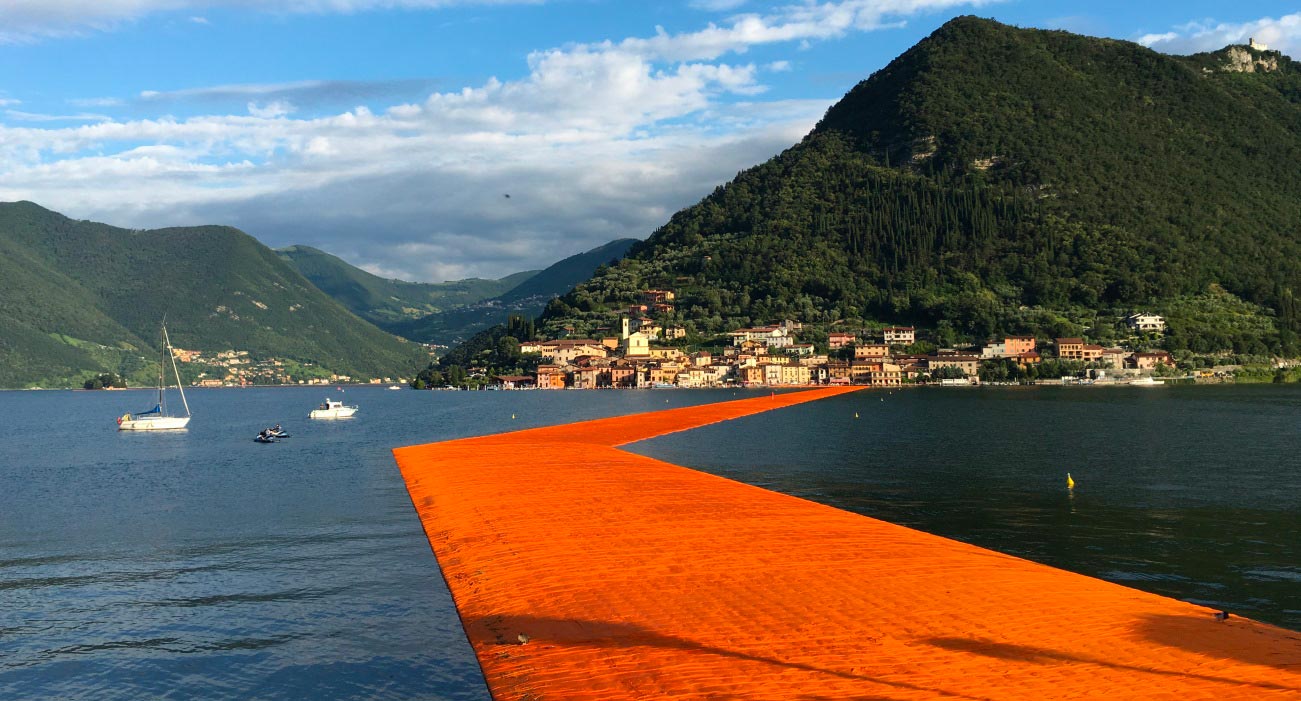
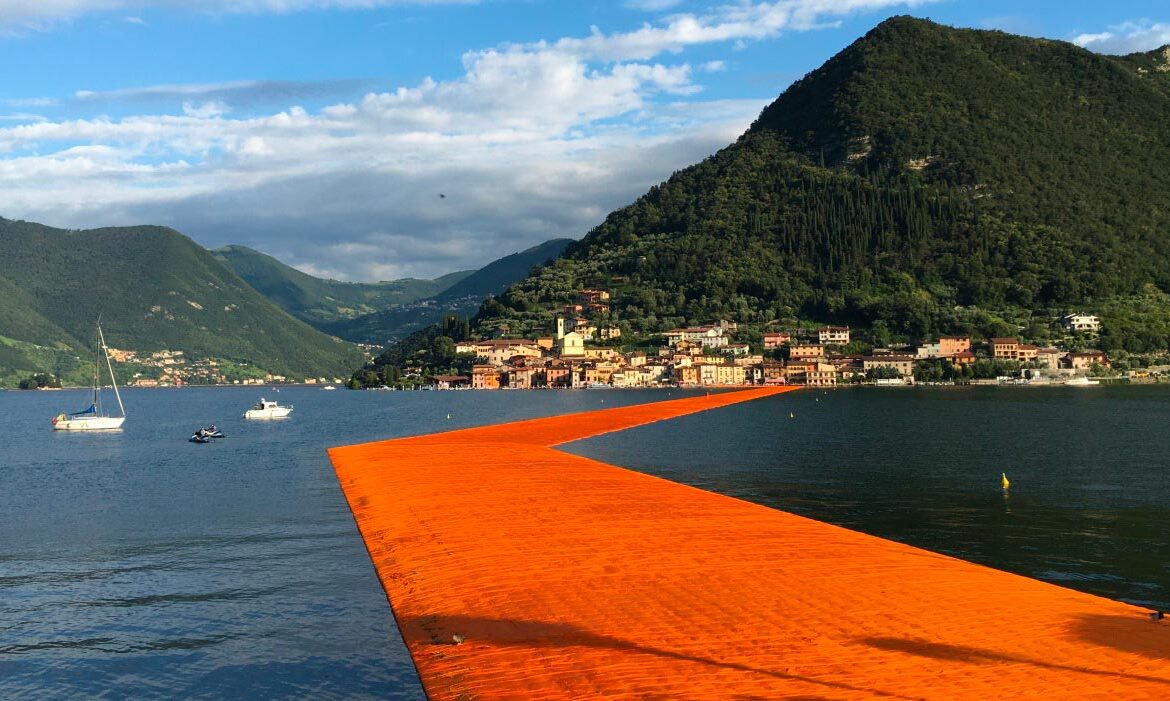
In the summer of 2016, Lake Iseo in northern Italy became the site of one of the most ambitious and talked-about public art installations of the 21st century: The Floating Piers by Christo and Jeanne-Claude. For just 16 days, visitors could literally walk on water, crossing the lake between Sulzano, Monte Isola, and the island of San Paolo on a shimmering ribbon of golden fabric.
An Idea Decades in the Making
Like many of Christo and Jeanne-Claude’s projects, The Floating Piers was not a spontaneous idea. The concept dated back to the 1970s, but it took more than 40 years to find the right location, technical feasibility, and political support. Lake Iseo—less famous than nearby Lake Como or Lake Garda—offered the ideal combination of scale, calm waters, and dramatic Alpine surroundings.
True to the artists’ principles, the project was entirely self-funded by Christo through the sale of preparatory drawings and models. No sponsorships, no branding, no advertising—just art.
Engineering the Impossible
The Floating Piers stretched approximately 3 kilometers and was made from 220,000 high-density polyethylene cubes, anchored to the lakebed with massive underwater weights. These cubes formed a stable, buoyant platform covered in a saffron-yellow fabric that subtly changed color with light, weather, and movement.
The surface was intentionally not rigid. As people walked, they could feel the gentle motion of the water beneath their feet, reinforcing the sensation of truly walking on the lake rather than on a conventional structure.
A Democratic Art Experience
One of the most striking aspects of The Floating Piers was its accessibility. The installation was open 24 hours a day and free to the public. No tickets, no reservations. Millions of visitors arrived from around the world, often waiting hours to step onto the piers.
Christo described the work as “a gift.” Once completed, it belonged entirely to the people who experienced it. There were no VIP entrances or privileged viewpoints—everyone shared the same path.
Light, Landscape, and Impermanence
The fabric’s color was carefully chosen. In sunlight, it glowed a warm gold; under clouds, it shifted toward orange or muted yellow. At sunrise and sunset, the piers seemed to merge with the sky and water, constantly changing with the environment.
As with all of Christo and Jeanne-Claude’s works, impermanence was essential. After 16 days, The Floating Piers was dismantled, and the materials were recycled. Nothing permanent remained on the lake, only photographs, memories, and the imprint of a collective experience.
Why It Still Matters
The Floating Piers was more than a visual spectacle. It challenged how people relate to landscape, movement, and public space. It turned a natural setting into an immersive, participatory artwork without altering it permanently.
For Lake Iseo, the project brought global attention. For visitors, it offered something rare: a moment of wonder that existed only briefly, reminding us that some of the most powerful experiences are temporary by design.
Walking on water was never meant to last. That was precisely the point.